IN EVIDENCE

Interobservation: a thought-provoking epistemological and methodological bridge between experimental phenomenology and programmed art.
Click here for the event program
Ivana Bianchi, Department of Humanities, University of Macerata, Italy
What we see —and share intersubjectively— is a fundamental common ground for OPK (Optical-Programmed-Kinetic) artists, as creators of visual objects to be seen and perceived by human beings who share the same visual system; viewers, as actors of the process of seeing; and vision scientists, who in any case share with all other observers this phenomenal level of experience as a starting point for their analysis. We will explore this statement, using the artistic and scientific works of Manfredo Massironi, a founding member of Gruppo N (an influential OKP collective in Europe from 1959 to 1966), who later shifted his focus from the art world to academia, becoming a respected perceptual scientist. We will then present the hypothesis that sharing this awareness with viewers might increase their cognitive engagement with and aesthetic appreciation of OKP artworks, and we will discuss this hypothesis within the framework of a dual model of aesthetic appreciation.

Thinking in Opposites to Improve Creativity (TOC): A Challenging Hypothesis for Cognitive Sciences and AI
Click here for the event program
Much remains to be understood in cognitive science about the nature and mechanisms of human creativity. Creativity poses a significant challenge to AI as well. Modeling human thought is difficult for convergent thinking, and even more so for divergent thinking. How can AI learn what is new, innovative, and creative according to human parameters?
In our project, “Thinking in Opposites to Improve Creativity (TOC): A Challenging Hypothesis for Cognitive Sciences and AI” (financed by the University of Macerata, project: Collaborative Research Constellation), we will examine the hypothesis that prompting individuals to think in opposites is an effective and simple method of stimulating creativity (TOC) in human performance and AI models. The meeting which will be held at the University of Macerata from June 3 to 5, 2025, entitled Stimulating and Measuring Creativity: A Research Project on Human and AI Performance, will open an in-depth discussion on the topic. Twenty-two professors and researchers from Italy (Macerata, Padua, Pisa, Rome, Turin, Trento, and Verona), Sweden, Denmark, the United Kingdom, and the United States will discuss the two intersecting themes of the project with Macerata colleagues: the development of creativity and the role of “thinking by opposites” in human cognition and AI.
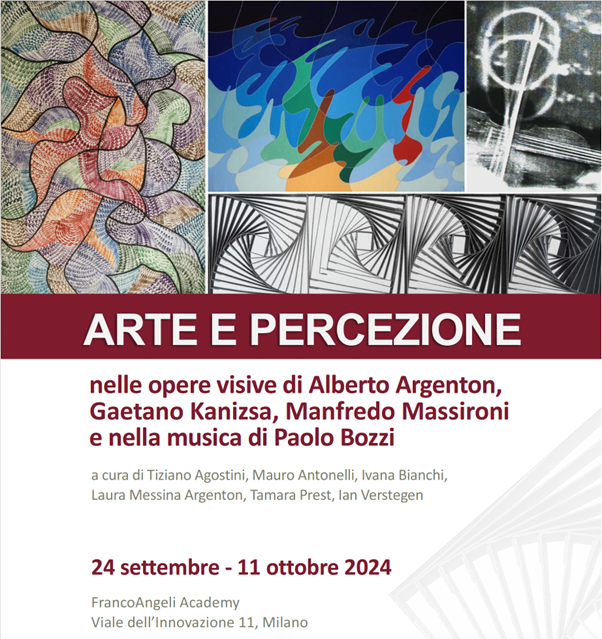
ARTE e PERCEZIONE
The exhibition presents a selection of visual artworks by Alberto Argenton (1944-2015), Gaetano Kanizsa (1913-1993) and Manfredo Massironi (1937-2011), accompanied by the music of Paolo Bozzi (1930-2003). They were professors of psychology who were active at the Universities of Padua (Argenton), Trieste (Bozzi and Kanizsa) and Verona (Massironi). In their scientific research, they focused on the study of the perceptual aspects of human experience and behavior, based on an approach which can be traced back to Gestalt Psychology – that was one of the cornerstones of Italian psychology in the second half of the twentieth century – and to the Psychology of Art, following the theoretical principles of the founding fathers of both disciplines (Max Wertheimer, Kurt Koffka, Wolfgang Köhler, Wolfgang Metzger, and Rudolf Arnheim). The four scholars also cultivated their own artistic research systematically, albeit with individual differences, and they shared their creations through exhibition activities or concerts. In some respects, their lives testimony not only the need but also the intent to embrace the scientific and artistic cultures at the same time: both by studying art through the scientific apparatus of Gestalt phenomenology (in which Argenton and Massironi were more systematic), and by creating art with mindful attention to perceptual aspects of the artwork. The exhibition is structured by themes, corresponding to some of the many perceptual phenomena studied in psychology, namely AMODAL COMPLETION, COMPLETION BY FRAME, ANOMALOUS FIGURES, PERCEPTUAL TRANSPARENCY, CONCAVITYCONVEXITY, and GOOD CONTINUATION. These themes appear in the captions next to the artworks and guide visitors in their observation but with a caveat: the works in the exhibition are not to be understood as demonstrations of the above perceptual phenomena; in them they can be found with the freedom of artistic invention, just as they are in the production of many other artists, being phenomena universally present in all domains of reality. The psychologist artists in this exhibition share an epistemological approach aimed at observing perceptual facts, phenomenal reality. Perception is the process of selecting and organizing stimuli from the external world. It is the primary process for orienting oneself in the world and is the foundation and driver of cognitive activity. However, due attention is not frequently given to perception in the reading of artistic work. But being aware of it and learning to observe art, as it offers itself to our phenomenal experience, is also vital to learn to perceive reality, to grasp its expressive qualities, to reason about perceptual facts, to exercise creativity and invent new realities (scientific and artistic).
Grounding Cognition in Perceptual Experience
Special Issue Journal of Intelligence, 2024
The aim of this Special Issue was to put forward a multifaceted reflection on the relevance of perceptual experience in affecting and modeling various aspects of cognitive performance. In our title, we explicitly chose to refer to perceptual experience (i.e., “Grounding cognition in perceptual experience”) rather than simply using the more familiar expression “Grounding cognition in perception”. This is because the latter approach has been characterized by a predominant focus on brain activity, whereas our aim here was to complement this valuable mainstream line of research with a different perspective that we also consider valuable. This perspective revolves around the question of what a phenomenological approach to
investigating the relationship between perception and cognition might be able to contribute to current research. We looked for answers to this question in a broad framework, covering a wide range of topics. How does perceptual experience contribute to the way in which we conceptualize experience? How is perceptual experience reflected in linguistic configurations? In what ways does perception influence people’s judgments, their unfolding reasoning process, and their memories? Each of the 13 papers in this Special Issue provides answers to these questions from a unique point of view.
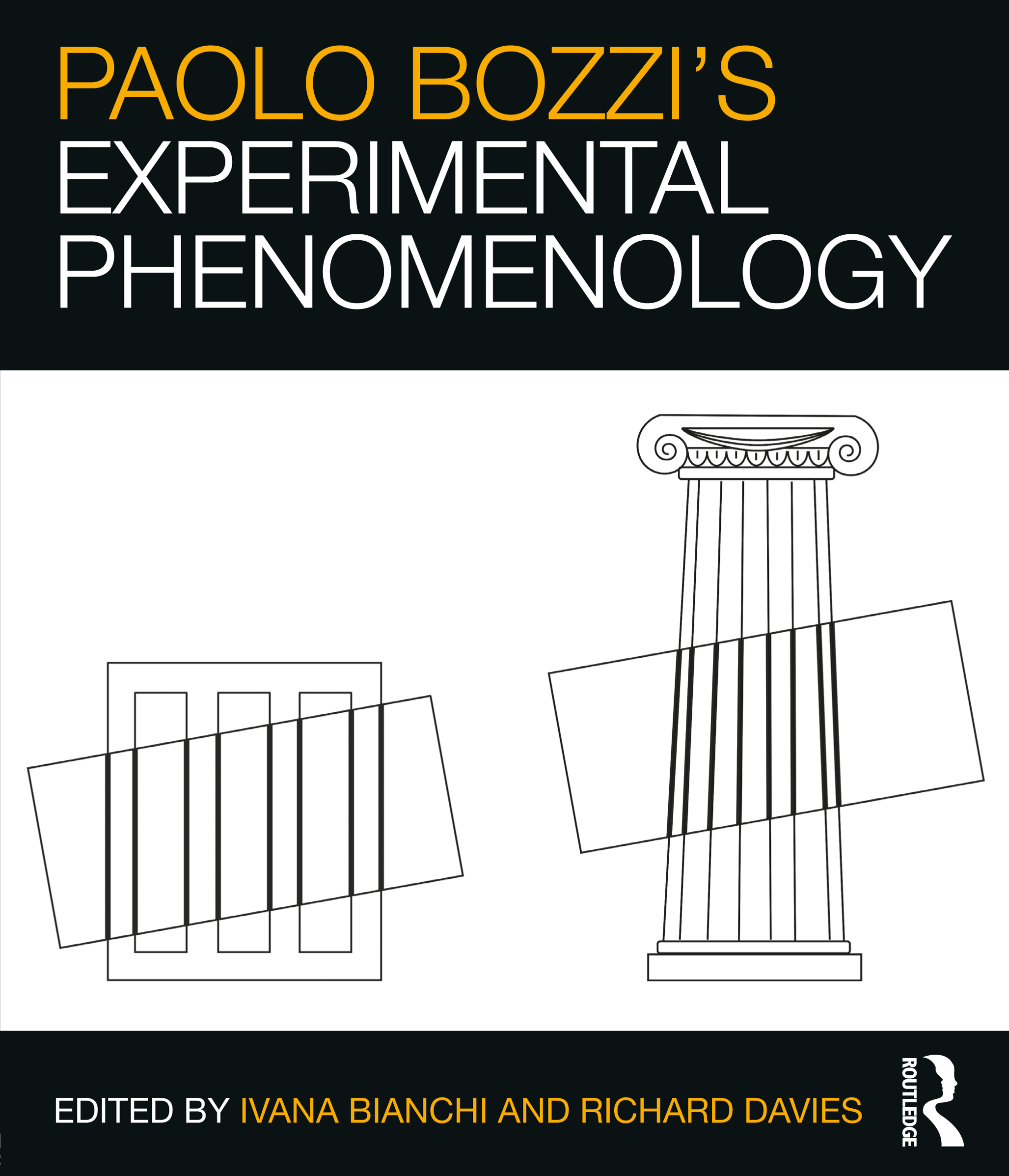
This anthology translates eighteen papers by Italian philosopher and experimental psychologist Paolo Bozzi (1930–2003), bringing his distinctive and influential ideas to an English-speaking audience for the first time. The papers cover a range of methodological and experimental questions concerning the phenomenology of perception and their theoretical implications, with each one followed by commentary from leading international experts.
In his laboratory work, Bozzi investigated visual and auditory perception, such as our responses to pendular motion and bodies in freefall, afterimages, transparency effects, and grouping effects in dot lattices and among sounds (musical notes). Reflecting on the results of his enquiries against the background of traditional approaches to experimentation in these fields, Bozzi took a unique realist stance that challenges accepted approaches to perception, arguing that Experimental Phenomenology is neither a science of the perceptual process nor a science of the appearances; it is a science of how things are.
The writings collected here offer an important resource for psychologists of perception and philosophers, as well as for researchers in cognitive science.

Manfredo Massironi e le sue ricerche visive insieme al gruppo N sono state al centro della memorabile mostra “L’occhio in gioco. Percezione, impressioni e illusioni nell’arte“, organizzata dall’Università di Padova Presso il Palazzo del Monte di Pietà (24.09.2022- 26.02.2023) per celebrare gli 800 anni dell’Università di Padova.

